Be wary of how you try to lose weight
This type of burning can increase heart attack risk
Matt Cook here, and nobody wants to carry around a lot of fat.
It looks bad, but it is also the source of inflammation and problematic hormones like estrogen.
Most people think that the only way to get rid of excess fat is to “burn it.”
But fat can be “burned” in a couple of different ways.
And the body can also get rid of fat without “burning” it.
Yet most people are led to believe that increasing “fat burning” (fatty acid oxidation) is good for your health.
Nothing could be further from the truth.
In one experiment, researchers showed that blocking excessive “fat burning” was protective against animals put through an experimental heart attack.
The researchers blocked excessive “fat burning” using a drug called mildronate.
Mildronate has been in the media in recent years – the tennis player Maria Sharapova was banned for doping using it.
Mildronate works by decreasing fatty acid oxidation (fat burning).
And it has numerous health benefits too.
Yes, we do want to get rid of excessive fat – but we do not want to increase fatty acid oxidation.
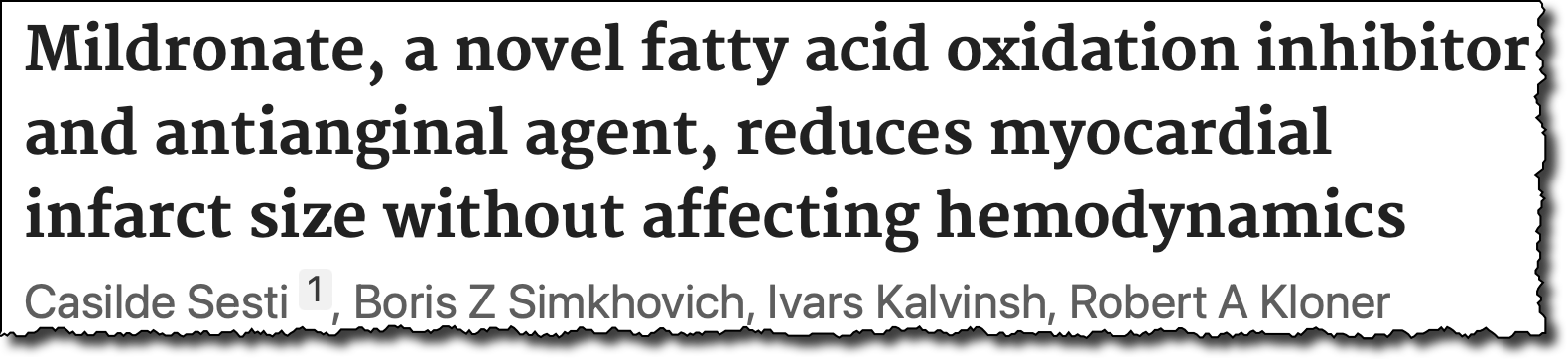
The animal experiments were performed at the University of Southern California, Los Angeles. The paper was published in The Journal of Cardiovascular Pharmacology.
Mildronate is known as a doping drug in professional sports.
But it also has other uses – in Europe it is used to treat angina.
“Mildronate is a fatty acid oxidation inhibitor approved as an antianginal drug in parts of Europe.”
The authors of this study wanted to know whether mildronate could reduce the amount of damage caused to the heart during a heart attack.
“We carried out the first study to determine whether a 10-day course of mildronate could reduce myocardial infarct size (IS) during acute myocardial ischemia.”
Infarction is tissue death from inadequate blood supply to the affected area.
Natural myocardial infarction is usually caused by a clot in or around the heart.
Some rats were given the fatty acid oxidation blocker and other rats were given this water instead in the days leading up to the experiment.
“Rats received 200 mg/kg/d of mildronate or sterile water subcutaneously for 10 days before ischemia-reperfusion.”
(Ischemia-reperfusion is the return of blood and oxygen after a period of deprivation — the rapid changes cause cell death.)
The rats were put through to different procedures designed to mimic a heart attack (myocardial infarction).
“Rats were then subjected to 45 minutes of left coronary artery occlusion and 2 hours of reperfusion.”
The procedure restricted blood flow to almost 40% of the heart tissue in the animals.
“The 2 groups had identical areas of heart tissue at risk: treated 38%; controls 38%.”
The researchers then looked to see how much of the heart tissue died.
There was more extensive damage to the heart tissue in the animals that were not taking mildronate.
Decreasing “fat burning” had a protective effect on the heart.
“The amount of necrosis was smaller in the mildronate group at 16% of the left ventricle versus controls, 22%.”
In another analysis, the researchers found that the animals given mildronate had less area damaged by the experimental heart attack.
“Myocardial infarct size was 43% in the mildronate-treated rats, and 57% in controls.”
Mildronate decreases excessive “fat burning”and this can have beneficial effects not just for sports performance.
Mildronate has a protective effect on the heart in animals which have experienced heart-attack.
“Our study for the first time demonstrated that a 10-day treatment with mildronate reduced myocardial infarct size in an experimental model of acute myocardial ischemia, without any effect on hemodynamics.”
The diets, exercise regimens and supplements used to massively increase “fat burning” are actually pretty bad for your health.
Ideally you want a slower but constant increase in fat use and to increase clearance of fat without being burned at all.
You should always consult your healthcare practitioner for guidance on medical diagnosis and treatment.
—-Important Message—-
How to lower your heart attack risk in 90 seconds
This 90 second “exercise” instantly relaxes the arteries and keeps them wide open and flexible…
And when the arteries are relaxed and open, blood flow improves.
And when blood flow is great, the heart works less and stays healthy at full-power.
So with this 90-second exercise, you can prevent heart attack, lower blood pressure, and even improve rockiness.
———-