You probably have some at home already
This tablet can reduce the risk of prostate cancer

Matt Cook here, and the reported risks of prostate cancer are overblown.
You are much less likely to develop problematic prostate cancer then you might suppose.
Most cases of “prostate cancer” are very slow-growing groups of cells that will never trouble the patient within their expected lifespan.
Doctors and specialists are finally coming around to this reality and are more often recommending observation rather than treatment.
But there are a minority of cases where prostate cancer diagnosis can be severe and risky.
Research shows that a common, over-the-counter pill can significantly reduce the risk of developing aggressive prostate cancer.
This pill also lowers the risk of cardiovascular disease and stroke.
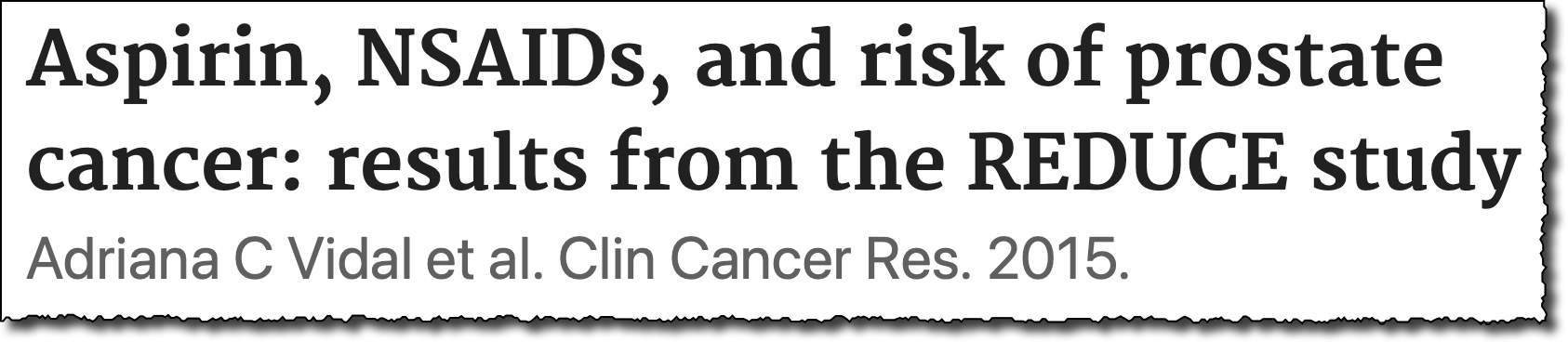
The human research was carried out at Duke University School of Medicine. The paper was published in Clinical Cancer Research.
The authors carried out an analysis of numerous studies which looked at the relationship between NSAID anti-inflammatories and prostate cancer.
NSAIDs include medications like acetaminophen.
“A recent meta-analysis showed that aspirin was associated with reduced prostate cancer risk.”
Previous studies had shown that these types of treatments can lower prostate specific antigen – also known as PSA – which is a general marker of inflammation of the prostate gland.
PSA is used as a marker for prostate cancer risk…
…but it’s not very specific and cannot detect if someone has cancer or not.
“Anti-inflammatory medications lower PSA, but whether these findings reflect reduced prostate cancer detection or lower prostate cancer risk is unknown.”
So, the authors looked at a number of studies which examine the role between these medications and genuine prostate cancer diagnosis – as determined by a biopsy of the prostate.
“We tested the association between aspirin and nonaspirin NSAID use on prostate cancer diagnosis in studies where all men received biopsies at 2 and 4 years.”
Most importantly, the researchers looked at the relationship between these medications and the Gleason score.
The Gleason score is based on the biopsy – and it tells us how problematic the cancer diagnosis really is.
“We examined the association between aspirin, NSAIDs, low-grade, or high-grade (Gleason ≥ 7) prostate cancer versus no prostate cancer.
Over 6000 men were included in the study – and the researchers had at least two biopsies on all of the men.
The results were calculated to take into account multiple factors which can affect prostate cancer risk, these included…
“… PSA, prostate volume, digital rectal examination, body mass index, smoking, alcohol, statins, hypertension, diabetes, and cardiovascular disease.”
They found an overall 15% reduced risk of prostate cancer in men taking aspirin.
This is similar to what has been seen in other studies.
“In unadjusted models, aspirin was associated with reduced prostate cancer risk (OR = 0.85).”
In the most accurate analysis the researchers looked at the relationship between this class of painkillers and high-grade, risky prostate cancer.
The research found a 20% reduced risk of dangerous prostate cancer in men taking these treatments.
“The use of aspirin and/or NSAIDs was significantly associated with high-grade prostate cancer risk.”
Numerous other studies have found that men who take a little bit of aspirin have a lower risk of prostate cancer.
Low-dose aspirin is safe – whereas the other medications used in this study have significant side effects.
Some of the research used in this study split men into two groups.
One group of men was using the prostate cancer treatment dutasteride.
The use of dutasteride had no effect on the benefits seen from aspirin and NSAIDs.
“Results were similar in placebo and dutasteride arms.”
Aspirin has been used for decades in order to decrease the risk of cardiovascular disease and stroke.
Research shows it can also significantly decrease the risk of dangerous prostate cancers too.
You should always consult your healthcare practitioner for guidance on medical diagnosis and treatment.
—-Important Message—-
Men: push this weird pressure point to shrink the prostate in 7 seconds
For 5,000 years, the Chinese have kept this prostate trick locked and sealed.
But the TRUTH is finally out.
By pressing this weird pressure point for 7 seconds you can dramatically shrink an inflamed prostate.
But only a few people know where this tricky pressure point is located exactly…
———-