It is the season of giving
This 1 factor makes you more charitable

Matt Cook here, and cortisol is a hormone which has a massive influence over our health.
It helps to regulate blood sugar and suppress inflammation.
But excessive levels of cortisol, produced under numerous kinds of stresses, chronically elevated cortisol leads to a lot of health problems.
Not only that, but elevated cortisol also affects our decision-making in profound ways.
For example, German researchers found that cortisol was a major factor in determining charitable behavior in people under stress.
It had a particularly profound effect on people who had a strong ability to imagine themselves in the situation of others.
Cortisol blocks empathy and decreases the likelihood of charitable behaviors.
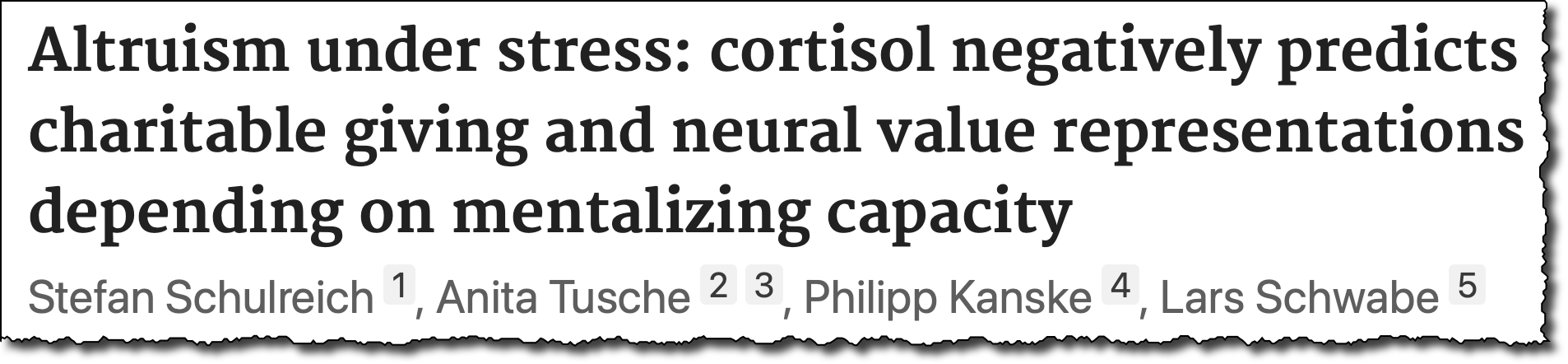
The human research was carried out at the University of Hamburg in Germany. The paper was published in the Journal of Neuroscience.
“Altruism, defined as costly other-regarding behavior, varies considerably across people and contexts.”
The authors of this study were interested in the effect of stress on altruistic and charitable behaviors.
“One prominent context in which people frequently must decide on how to socially act is under stress.”
They wanted to know whether stressful situations could lead to changes in mental processes which then alter how people act.
“How does stress affect altruistic decision-making and through which neurocognitive mechanisms?”
They looked at brain patterns, behavior and hormones in people put through stressful situations while their altruism was under scrutiny.
“To address these questions, we assessed neural activity associated with charitable giving under stress.“
The researchers looked at charitable behavior before and after people were put through a situation designed to elevate their stress levels.
“Participants completed a charitable donation task before and after they underwent either a psychosocial stressor or a control manipulation.”
The researchers tracked many things including brain activity using fMRI scans.
“All the while their brain activity was measured using functional magnetic resonance imaging (fMRI).”
The researchers were also interested in something they called mentalizing.
Mentalizing is the ability for a person to imagine somebody else’s mental state.
“Mentalizing predicts prosocial giving and may be susceptible to stress. We examined whether stress effects on altruism depend on participants’ general capacity to mentalize, as assessed in an independent task.”
The researchers were surprised to discover that cortisol was really the only factor which predicted changes in charitable and altruistic behavior.
People with a strong ability to imagine somebody else’s mental state were less charitable when their cortisol levels increased.
“Although our stress manipulation per se had no influence on charitable giving, increases in the stress hormone cortisol were associated with reductions in donations in participants with high mentalizing capacity.”
The study shows that anything which increases cortisol can affect decision-making.
It seems to interact particularly with the ability to empathize in a very specific way – mentalizing.
“Our findings suggest an impact of the stress hormone cortisol on mentalizing-related neurocognitive processes, which in turn results in decreased altruism.”
Looking out for the welfare of others when there is nothing obvious in it for the individual is a major part of a healthy society.
Social, psychological, economic, and dietary stresses all increase cortisol which can have a significant detrimental effect on the society that we live in.
“Altruism is a fundamental building block of our society. Emerging evidence indicates a major role of acute stress and stress-related neuromodulators in social behavior and decision-making.”
I write a lot about the negative effects of cortisol on other hormones, body weight, and risk of potentially fatal diseases.
But cortisol also negatively impacts people’s decision-making…
That is yet another reason why we should take steps to keep cortisol under control.
“How and through which mechanisms stress may impact altruism remains elusive. We observed that the stress hormone cortisol was linked to diminished altruistic behavior.”
You should always consult your healthcare practitioner for guidance on medical diagnosis and treatment.
—-Important Message—-
This pleasure hormone works 1.8x better than testosterone

Most men think testosterone is the most important hormone for getting great male rockiness…
But the truth is, there’s something that works even better — and it also increases the amount of pleasure you feel from sex.
I call it the pleasure hormone, and I discovered it after stumbling onto a secret group of sex experts online…
All of them have been using this natural hormone to get bigger, better erections and last as long as they want…
…all while feeling pleasure ALL over their bodies, not just in their members…
And the best part? It’s fully natural. Your body already makes this hormone on its own.
———-