Should we be worried or not
Are they right about antibiotic resistance?

Matt Cook here, and periodically, the threat of antibiotic resistance makes the news.
It’s a serious issue that is already affecting health outcomes for people.
Antibiotic resistance can lead to longer hospital stays and in rare cases, death.
Antibiotic resistance represents one of the largest threats to global public health, food security and global development faced today. Due to the spread of antibiotic resistance, a growing number of infections, such as pneumonia and tuberculosis, are becoming harder to treat, leading to longer hospital stays, greater costs and increased mortality.
Obviously antibiotic resistance is a real problem and as of now, there is no real solution to the problem.
Normally, antibiotic resistance is blamed on too much antibiotic use.
That’s the reason you typically see in news headlines and reducing antibiotic use is also often a clinical goal of medical practices.
That’s why the recommendation from public health agencies to curb antibiotic resistance is usually to cut down on antibiotic usage.
“Many public health agencies have recommended reducing antibiotic use in response to the challenges caused by resistance,” explains co-author Léa Pradier, a former PhD student at University of Montpellier, France.
But what if the use of antibiotics isn’t the problem?
After all there are plenty of places that have reduced their antibiotic use and haven’t reduced the spread of antibiotic resistance.
“However, there are cases where developed countries have reduced their antibiotic consumption and not halted the spread of antibiotic resistance genes across bacterial populations, implying other factors are at play,” continues Pradier.
So what’s going on here?
Honestly, I’ve been skeptical of this explanation of antibiotic resistance for a long time…
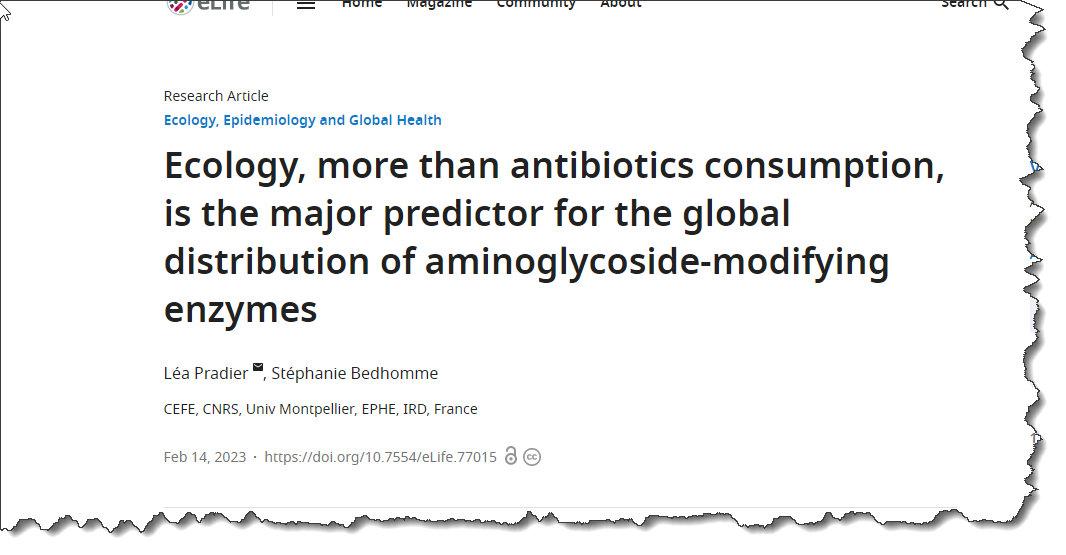
And research published in eLife is providing a potentially new and quite different explanation for why we’re experiencing antibiotic resistance.
In this study, the researchers focused on a specific type of antibiotics called aminoglycosides.
These antibiotics aren’t used much in humans, but are used extensively in animals.
What the researchers found is that human trade is carrying antibiotic resistant traits between biomes and is causing antibiotic resistance to spread!
Instead, the dataset implies that human exchanges through trade and migration, and exchanges between biomes, explain most of the spread and maintenance of antibiotic resistance when modelled over time, space and ecology.
This is a vastly different explanation than the idea that overuse of antibiotics is causing antibiotic resistance.
The findings suggest that the largest cause of AME gene spread is through the movement of antibiotic-resistant bacteria between ecosystems and biomes. This spread is aided by mobile genetic elements, which increase the likelihood for a genome to carry several copies of the same AME gene. This increases the expression of transferred AME genes and allows bacteria to evolve new antibiotic resistance functions through the duplicated sequences.
The idea that humans are spreading antibiotic resistant bacteria and causing those populations to grow through trade is novel, but entirely plausible.
This study is limited to the specific type of antibiotic resistance that the researchers studied…
But I would love to see these methods focused on other types of antibiotic resistance as well to see if these findings hold true across other types.
“Although the conclusions of this study should not be extended to antibiotic genes other than AMEs, the methods used could easily be applied to further studies on other antibiotic resistance gene families.”
Antibiotics are one of the most important interventions we have in modern medicine.
It’s important that we understand why resistance to them is really happening and figure out what to do about it.
—-Important Message—-
How to get her super wet without even touching her (yet)

You’re about to discover some of the most closely-guarded “instant O” secrets that exist…
…secrets not one in ten thousand men know about…
Here’s what one man has to say about this “no touch” technique…
“I dated a girl once and all I had to do was count to three the right way. No touching. And she came so hard.”
Discover this “no touch” secret women are going wild for
———-